Recipe for Phenomenal Health and Wellness according to the Book of Leonidas

Recipefor Phenomenal Health and Wellness according to the Book of Leonidas
By Rev. Leonidas “The Optometrist” Johnson
October 24, 2026
We live our lives, like a book, as a tale that is told (cf. Ps.90:09). In my life I have mastered a recipe for health and wellness. It’s not the only recipe but I think it is pretty good and so do many others. That’s whyI am going to share this recipe with you. Perhaps you may not find this to your liking. If not, no problem. Don’t toss it away. Put it on the shelf. It may help extend or even save your life one day. Of course, the decision is yours!
Health and wellness are not limited to the physical Body. Health and wellness involve the Soul, that is, our emotional, mental, social, and volitional (i.e., human will, will-power, decision-making) health. Health and wellness also involve the human Spirit, that is, our spirituality. Health and wellness involve the Body, Soul and Spirit.
An approach to health and wellness that addresses the body, soul, and spirit is generally described as holistic, or as a bio-psycho-social-spiritual model. My recipe is a holistic approach to health and wellness. Other important terms and concepts related to a holistic approach to health and wellness include the Illness-Wellness Continuum and Salutogenesis
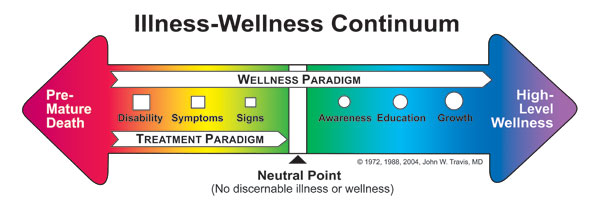
The Illness-Wellness Continuum is a graphical model introduced by Dr. John W. Travis in 1972 (and published in 1975) that illustrates health as a dynamic, ongoing spectrum rather than a fixed state. The neutral point located in the middle of the continuum stands for the absence of physical signs, symptoms or disease. The left side moves from the neutral point toward worsening health and ultimately premature death. The right side moves from the neutral point toward higher levels of wellness, and ultimately fullness of life.
The Salutogenic model of health is an interdisciplinary framework created by medical sociologist Aaron Antonovsky in 1979. Instead of asking "What causes disease?"(pathogenesis), it asks the Salutogenic question: "What creates and maintains health?" Like the Illness-Wellness Continuum, the Salutogenic model has an Ease/Dis-ease Continuum where people exist on a dynamic continuum between total health (Ease) and total illness (Dis-ease) at any given time. Another core concept of the salutogenic model is Sense of Coherence. Sense of Coherence includes the feeling that life has an emotional and existential purpose, that stress is a universal part of human life, and life’s challenges are worth investing time and energy in resolving. Sense of Coherence is related to the concept of worldview. For example, there are people who consider themselves as being spiritual and believe in the one and only, true and living God, creator of heaven and earth. This is a worldview. There are people who consider themselves as being spiritual but do not believe there is a God or believe there are many gods, not just one. This is another example of a worldview. There are people who consider themselves as being nonspiritual and do not believe in the existence of God or gods. This is a third example of a worldview. The concept of worldview and the idea of sense of coherence, significantly affects how we deal with life stressors.
Modifiable factors (lifestyle and environment) like diet, exercise, alcohol, and stress account for the majority or preventable premature deaths and chronic diseases.[1] According to CDC Chronic Conditions Surveillance 76% of US adults live with at lease on chronic condition and 51.4% live with multiple chronic conditions.[2][3] The World Health Organization (WHO) and peer-reviewed global burden assessments indicate that approximately 60% to 63% of all global deaths are driven by non-communicable chronic diseases (such as cardiovascular disease, cancer, chronic respiratory disease, and type 2 diabetes), the vast majority of which share preventable lifestyle roots.[4] Medical research estimates that 70% of serious diseased populations are believed to be effected by chronic stress.[5][6][7]
My recipe for health, wellness and fullness of life starts with maximizing physical health and wellness. There are basically three areas to focus on to maximize physical health and wellness: (1) Diet; (2) Exercise; and (3) Stress Management. These modifiable factors do not require significant added costs and can be achieved with the aid of free health apps and AI (artificial intelligence) search features designed for mobile phone device use. Apps to help with personal diet, exercise, and stress management are in abundance. The transformative shift in the healthcare landscape, where access to health information, resources, and decision-making power is increasingly shared between healthcare providers and patients is called the democratization of health.
Recipe for Physical Health, Wellness and Fullness of Life
A. Body - Physical Health
1. Healthy Diet
a. Things to Add, Increase or Maintain
i. Antioxidants
1. Leafy Green Vegetables
2. Fruits high in Antioxidants (e.g., Acai, Pomegranate,Aronia berry juice, …)
ii. Fiber
1. Multigrain Bread (e.g., Ezekiel 4:9 organic sprouted bread and cereals)
b. Things to Eliminate, Decrease, Limit
1. Tobacco Use (Smoking/Vaping) - a primary driver of lung disease, cardiovascular disease and multiple forms of cancer (Best to Eliminate this item)
2. Excessive Alcohol Use – linked to liver disease, high blood pressure, certain cancers, and annual deaths.
3. Highly Processed Sugars (added and refined)
4. Ultra-processed foods (UPFs) and meats
5. Sodium (salt) Intake
6. Fired Foods / Fast Foods
2. Exercise
a. Walking/ Steps
i. Soleus muscle – “The second heart”
b. Water Intake
i. Water Source and Container Considerations
c. Sleep
i. Rest & Recovery
1. Sleep Cycle
a. Deep Sleep
b. Sleep routine/ritual/ practice/habit.
3. Stress management
a. Mindful Meditation
b. Biofeedback
c. Professional counseling (legal, financial literacy, premarital, marital, spiritual, ...)
d. Traditional East Asian Medicine (acupuncture, qi gong, …)
e. Joyful attitude, laughter, and cheerfulness has healing power (cf. Proverbs 17:22)
No matter where one may be on the Illness-Wellness or Salutogenesis Ease / Dis-ease continuum, movement toward optimal physical health and wellness (ref. The Body) serves as a foundation for optimal emotional, mental, social, and volitional health and wellness (ref. The Soul) and optimal spiritual health and wellness (ref. The Human Spirit).
Health and wellness are shared responsibilities. A doctor cannot heal a patient against a patient’s will. The patient must want to be healed and believe healing is possible. Members of a patient’s healthcare team can help with the healing process, but the actual work of healing is the patient’s responsibility. An individual must decide if they want to improve their health and wellness and put in the work needed to move from where they are to better to best health, an increased sense of wellness and ultimately fullness of life. The decision to move toward optimal health and wellness relative to an Illness-Wellness / Ease – Dis-ease Continuum in the realms of the Body (physical health & wellness), the Soul (emotional, mental, social, and volitional (i.e. decision-making skills) health and wellness) and the Spirit (spiritual health and wellness) is the path to a phenomenal fullness of life experience.
[1] https://www.sciencedirect.com/science/article/pii/S2542454823000577
[2] https://www.cdc.gov/pcd/issues/2025/24_0539.htm
[3] https://pmc.ncbi.nlm.nih.gov/articles/PMC12007472/
[4] https://pmc.ncbi.nlm.nih.gov/articles/PMC10365307/
[5] https://pmc.ncbi.nlm.nih.gov/articles/PMC4791152/
[6] https://pmc.ncbi.nlm.nih.gov/articles/PMC5137920/
[7] https://pmc.ncbi.nlm.nih.gov/articles/PMC11353953/
More Articles





Stay informed, inspired, and ahead of the curve with expert tips, vision care insights, and holistic eye health updates — delivered straight to your inbox.